
Seam Reinforcement in Flat Roofs at Parapets

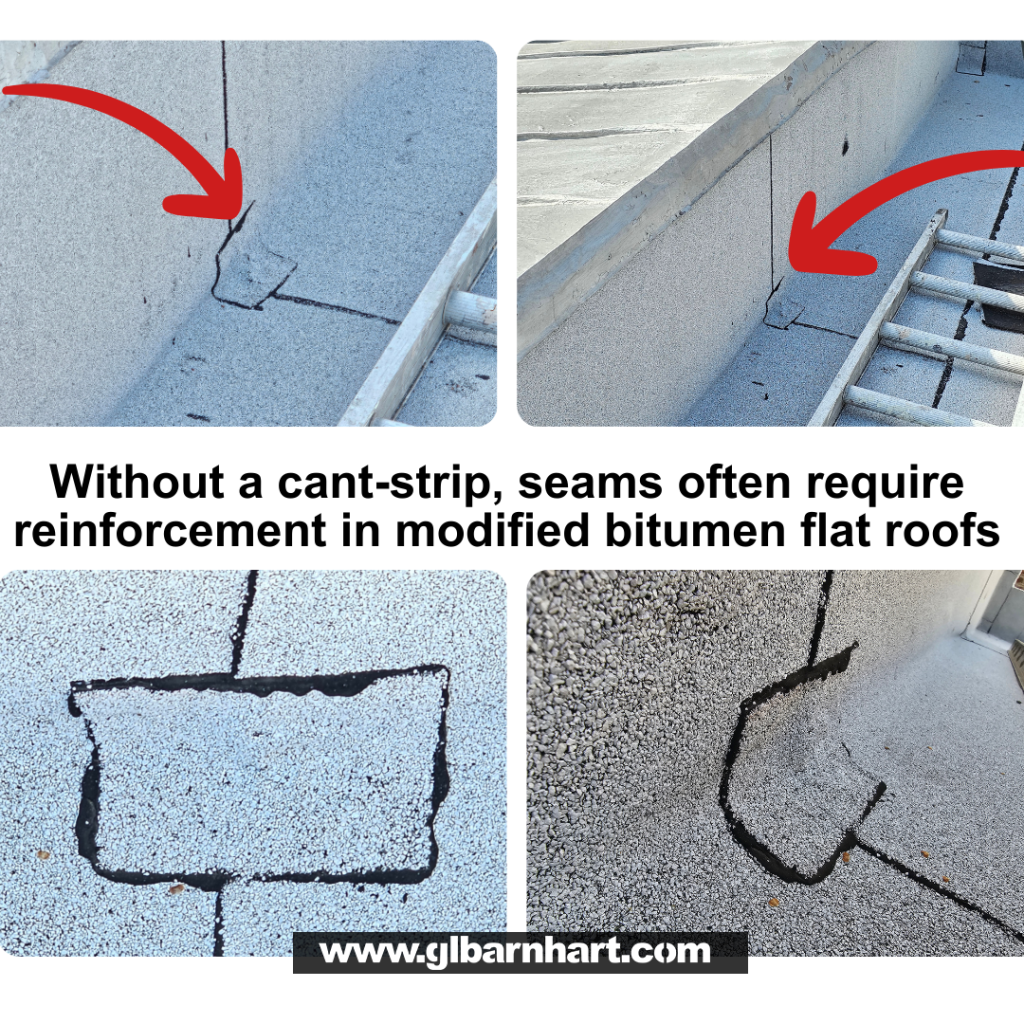
Without a cant strip, seams often require reinforcement in modified bitumen flat roofs.
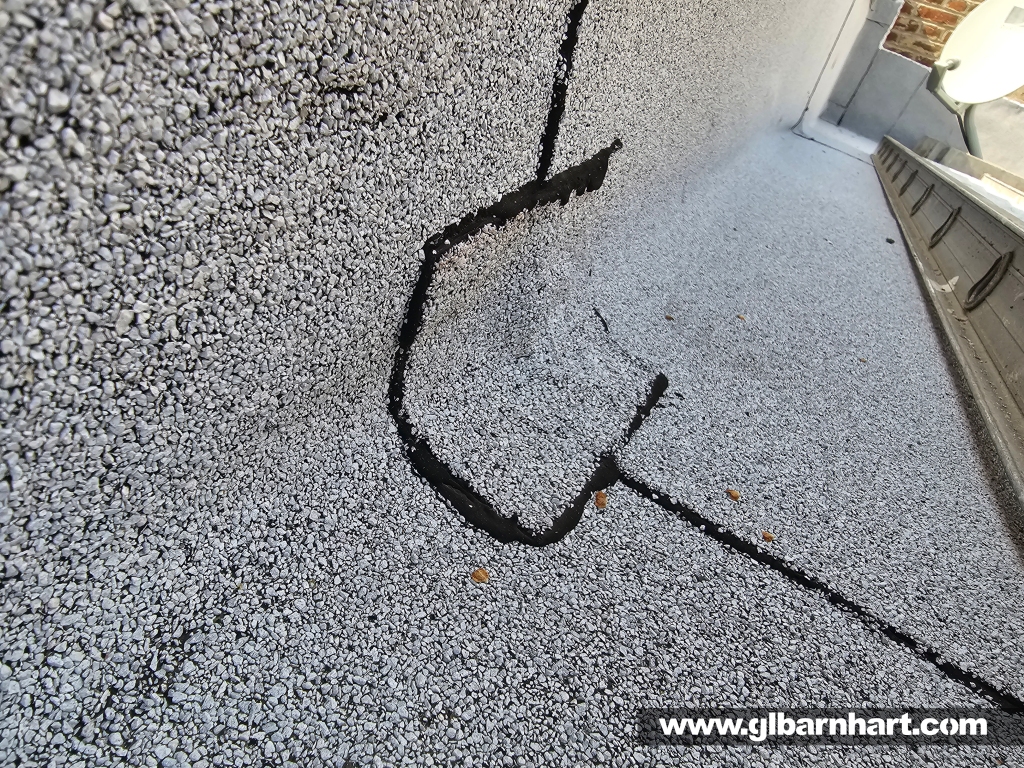
A cant strip is a triangular shape strip of material, installed under the roof membrane, at the substrate, between the wooden or concrete or steel, in most commercial buildings). In some cases can strips can be built with a homosote or even a wood material. These strips are installed inside of the 90° corner or angle between the horizontal or low slope roof system and the vertical parapet wall. Often, in between joined buildings, where there’s a side to side joint separating buildings, the parapet will be relatively low, just working or used as a point for demarcation for termination of the roof membrane. Often this parapet is just a portion of the brick demising wall that extends above the roof line, particularly between historic buildings in Capitol Hill.
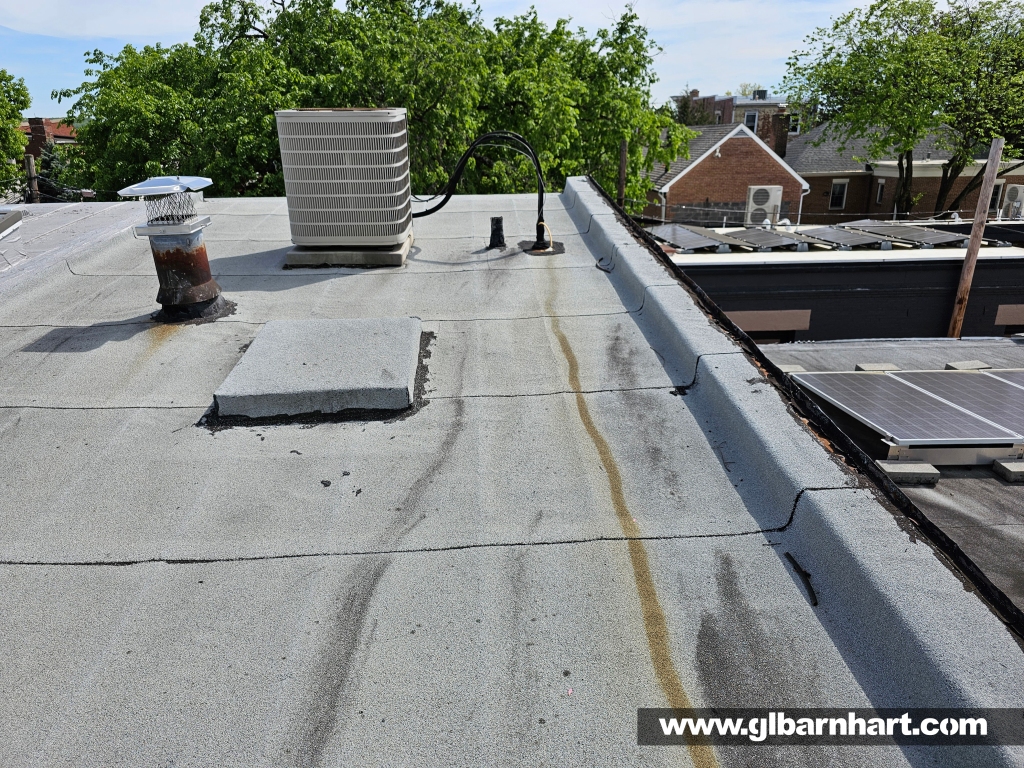
Modern Single-ply Flat Roof Systems
The types of flat roof systems encountered can generally be categorized into several main groups. One of the most prevalent flat roofing systems in Capitol Hill is modified bitumen roofing. This type of roofing membrane is composed of asphalt that has been modified with plastics or synthetic rubbers to enhance its durability and weathering capabilities. (One of the most common misnomers in the industry is that people often refer to a wide variety of different roof types as “rubber roofs”, but none of them are actually rubber.
Particularly modified bitumen, one of the most commonly mistaken and mislabeled roofs, is one of the farthest from what we think of as rubber, yet it has some chemical similarities. We examine this further below.) Modified bitumen roofs can be installed either as a multi-ply system with reinforcement plies between the waterproofing layers, or as a single-ply membrane adhered or mechanically fastened to the roof deck. Single-ply membranes are generally at least slightly thicker and have more interstitial material layers within the overall single-ply. By comparison, to modified bitumen roof systems, we think of EPDM roof systems as more similar to what people generally recognize as being a rubber-like material. EPDM is very similar, both in appearance and on a chemical level, to a tire inner tube.
The pictures below show an uncoated modified bitumen flat roof membrane.
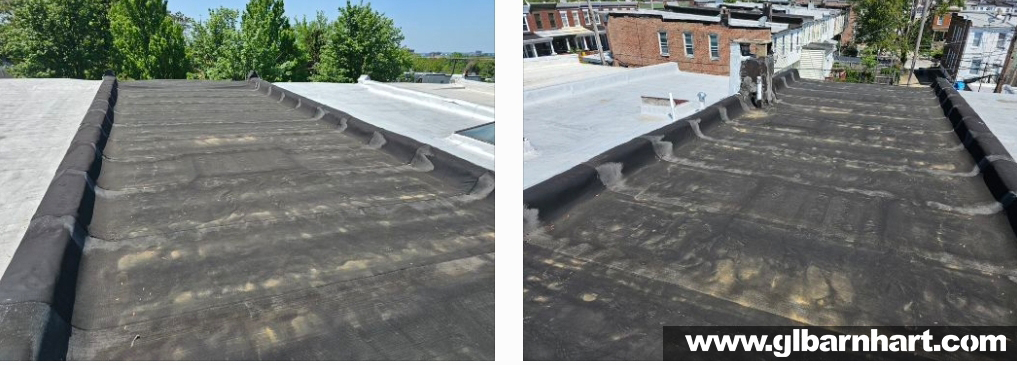
This single-ply membrane, of modified bitumen, itself consists of asphalt that has been modified with polymers like APP (Atactic Polypropylene) or SBS (Styrene-Butadiene-Styrene). These chemical materials enhance the modified bitumen roof membrane’s flexibility, durability, and weathering resistance. The membrane can be torch-applied, hot-mopped, or self-adhered. Far and away, the torch-applied type application is the most common, here in Capitol Hill. In historic times, and in much larger Industrial configurations, hot mopped materials were more prevalent.
A typical single-ply modified bitumen membrane is a composite material made up of several layers or components sandwiched together:
Asphalt Compound: The primary component is the asphalt compound, which acts as the waterproofing and binding agent. The asphalt is modified with polymers like APP (Atactic Polypropylene) or SBS (Styrene-Butadiene-Styrene) to enhance flexibility, durability, and aging characteristics.
Reinforcement: Embedded within the asphalt compound is a reinforcement layer, typically made of either a non-woven polyester mat or a fiberglass reinforcing fabric. This reinforcement provides tensile strength, dimensional stability, and resistance to tears and punctures.
Surface Coatings: The top surface of the membrane often has a mineral granule surfacing or a polymer film coating applied. These surface treatments protect the membrane from UV radiation, improve fire resistance, and provide additional durability and traction.
Bottom Coatings: On the underside, the membrane may have a sand, talc, or polyethylene coating to prevent sticking during installation and provide a slip-resistant surface.
Additional Layers: In some cases, additional layers like reinforcement scrims, oxidized asphalt coatings, or fire-resistant mica sheets may be incorporated into the membrane’s composite structure to enhance specific performance characteristics.
So in essence, while it may appear as a single homogeneous layer, a typical modified bitumen roof membrane is actually an engineered composite materials containing asphalt, polymer modifiers, reinforcing fabrics/mats, and various surface coatings and treatments – all manufactured to work together to provide a degree of waterproofing, durability, and longevity for the roofing system.
Flat Roof Seam Separation
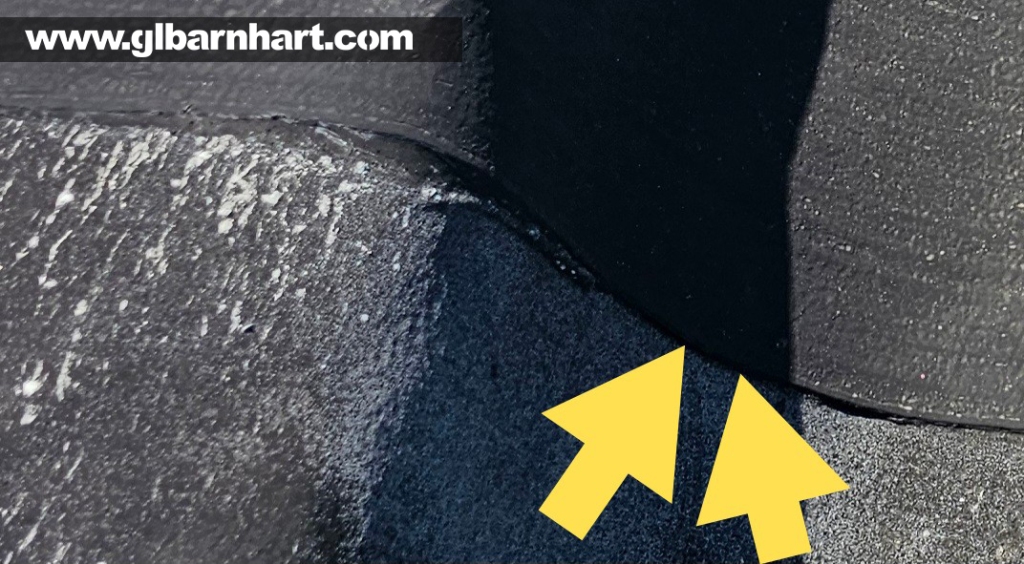
We took the pictures below at a rooftop and Capitol Hill, recently. Where there is an angle or an upturn at the low slope or horizontal flat roof system and the vertical parapet wall, there’s a 90° corner at the junction. A 90° corner like that is a bit steep for modified bitumen roofs because the membrane, when flexed at that sharp of a degree or angle has a tendency to want to separate from itself in the lap joint because there’s both structures of flexibility and rigidity in the same assembly of materials but those forces and materials are under stress with thermal forced movement of expansion and contraction.
In the collage of pictures below you can see where an overlay was applied just to add additional reinforcement at that corner. Without that type of additional reinforcement, there’s a high prevalence that fish mouthing or gapping separation could occur at that corner overtime.
Earlier, we mentioned the use of the word “rubber”, and although there are an abundance of misnomers in the industry there is a connection between actual rubber and the rubber moniker used for some of these modern materials.
Cant Strips Reduce the Drastic Angles
At the 90° angle found where a low slope or near horizontal slope roof meets and adjoining wall or parapet, a can strip which is essentially this triangle type shape material that fits into that corner, the material will divide the angle of transition, in half. Because of the internal dynamics of the materials and the stresses of the materials when they are overlaid together, with thermal movement driven by extreme sunlight and changing weather conditions throughout the year, these pressures and forces are stressors that pull these materials apart from one another. Where cant strips are installed, the extreme angle of the transition between horizontal to vertical surfaces is divided in two, so the resultant geometric angle that the roof material must cover is cut in half. That modification or change of the contour of the roof substrate surface allows the roof material to adhere and stay connected, in shape, much better, over time.
On modified bitumen roofs the lack of a cant strip (at the area of a transition) at projections and angle changes can lead to seams that open over time. These seams often require additional reinforcement. Installing cant strips provide a gradual slope transition to avoid this issue.
Another flat roof system common in the historic Capitol Hill area is built-up roofing (BUR). This traditional type of roofing consists of alternating layers of reinforced fabric or mat and hot-applied asphalt waterproofing membranes, typically surfaced with gravel or cap sheets. While very durable, built-up roofs require regular maintenance due to their multiple plies and layers. These root systems have largely faded from use in modern times because of several reasons which will look at more closely in an upcoming future blog article.
Chemical Combinations in Flat Roof Materials.
On a fundamental level, many flat roofing membranes and accessories share some key similarities with an unexpected everyday product – the rubber used in vehicle tires. These connections are rooted in the materials’ chemistry and material science. It helps a bit to look at it in the context or make the comparison between the rubber roof system of an EPDM roof and some of the internal substrate components in other single-ply roof membrane systems and tires used in our typical vehicles today.
At their core, both roofing and tire rubber compounds contain long, flexible chains of monomers called polymers. For roofing, synthetic rubbers like EPDM (ethylene propylene diene monomer) or the asphalt modifiers in modified bitumen provide this polymeric foundation. These hydrocarbon-based chains allow the materials to remain pliable and elastic.
When looking closely at the material science and the mechanics of material deterioration, we often look at degradation driven or calls by exposure to ultraviolet rays. Unlike some other natural and Classic Building Materials like brick, used in typical structural construction, both historically and in modern contexts, masonry materials have almost complete resistance to degradation related to ultraviolet exposure. Other materials though, in contract, like wood, plastics, and rubber or synthetic polymers are heavily degraded, and quickly by exposure to ultraviolet light.
Just as natural rubber undergoes vulcanization by adding sulfur to create cross-links between the polymer strands, many roofing rubbers go through a similar curing process. This enhances durability, chemical resistance, and crucial weathering capabilities, to a degree. The original discovery and forthcoming innovations and inventions of the vulcanization of rubber, and associated processes led to the development of the tire and automotive industry as we know it today. Also, if you look closely at the ownership structures of the big corporate Juggernaut companies that manufacture the majority of the industry’s roofing materials, there are interconnections between roofing manufacturers and tire companies. Firestone is a particularly easy one to connect because they sell both tires and roofing materials under the same well-known business name, which doesn’t in itself make them better but it’s an interesting connection.
But it’s not just about the rubber polymers themselves. Flat roofing systems often incorporate reinforcing materials like polyester fabrics or fiberglass mats, mimicking the reinforcing belts and plies found in tire construction. This multi-component design increases strength, puncture resistance, and dimensional stability.
Performance-enhancing additives are another shared parallel between roofing membranes and tires. UV stabilizers, fire retardants, antioxidants and mineral fillers help roofing stand up to the harsh effects of the elements, just as tire formulations leverage similar compounds for longevity on the road.
This multi-layering of materials creates systems that are better fit for flat roof use. Both roofing and tire rubber formulations prioritize weathering resistance against UV radiation, temperature extremes, moisture penetration and oxidative aging. Their ability to remain flexible yet durable over time is a central design factor.
In recent decades, single-ply membrane roofing systems like thermoplastic polyolefin (TPO) and polyvinyl chloride (PVC) have gained popularity for their superior durability and heat-reflecting white surfaces. TPO and PVC roofs consist of a single, flexible synthetic membrane that is either adhered, mechanically fastened or ballasted to the structural roof deck or substrate. TPO membranes are slightly more expensive but significantly more durable and have much higher reflectivity coefficients than modified bitumen roofs and higher durability than PVC roofs.
On some of the historic Capitol Hill row homes and smaller residential buildings, we also infrequently work on some traditional standing-seam terne and metal roofing systems. While often requiring specialized repairs, these historic metal roofs can continue to work, in some cases, if properly maintained. Flat-seamed metal roofs laid with solder-joined metal pans were also found occasionally, in the neighborhood, but in much lower frequency today than just 30 years ago.
In addition to the primary waterproofing membranes, proper flashing details and tie-ins are critical components of a reliable flat roofing system. We often say a roof system is only as strong as its weakest link. It might sound like a cliche, but it’s abundantly clear, when a leak does happen that even an otherwise entirely good roof system can be rendered in essence ineffective by one defect, even when it happens from a secondary or tertiary type element like a flashing or a transition metal. Here in Capitol Hill, GL Barnhart Construction is accustomed to working on complex roofing conditions which are characteristic of historic Washington DC architecture.
Capitol Hill’s Unique Elements
Another variable is the type of structural deck over which the roofing is installed. Many Capitol Hill row homes have the original 1x wood plank substrate decks, which can present challenges like loose and protruding nail heads which have worked free after decades of shrinking and swelling wood. Commercial buildings may have poured gypsum, lightweight insulating concrete or various types of rigid board insulation installed over the structural framing as part of the roofing assembly.
With such a diverse range of flat roofing types and material integrations, providing long-lasting and comprehensive solutions requires practical experience across all of the systems involved. Having worked on over 1,000 buildings throughout Capitol Hill, GL Barnhart Construction has developed a close familiarity with the unique conditions and details present in the neighborhood’s historic infrastructure and building assemblies.
From brick restoration and repointing work, to complex historic roofing repairs and modern single-ply replacements, the company’s experience covers a wide-spectrum of flat roofing scenarios.
Maintaining the integrity and protection of these historic buildings requires periodic roof system evaluations / assessments and proactive measures to address areas of potential concern before developing into larger problems. Through GL Barnhart’s assessment and maintenance program, many property owners can maximize the service life of their existing roofs.
Ultimately, regardless of the specific type of flat roofing involved, a customized solution tailored to the project’s unique conditions and performance requirements is generally effective. Our company has a concentrated specialization and experience with the distinct properties of Washington D.C.’s Capitol Hill neighborhood. As a flat roofing specialist serving the historic Capitol Hill neighborhood of Washington D.C. for over a decade, GL Barnhart Construction has extensive experience working with the various flat roofing systems found on the buildings in this area. If we can help with a flat roof in Capitol Hill, reach out to us at our website and we’ll be in touch: www.glbarnhart.com.


Comments